A Republic in Ink

A Republic in Ink

History decides what happens to the country. Your choices decide what happens to the people who depend on you.

Interactive historical fiction for iPhone and iPad. Carry the printers' letters up and down the coast through two American wars, and decide, at every press, what goes into the paper.

  • Two books
  • Every word read aloud
  • A painting for every scene
  • First chapter of each book free

In development · Coming soon

For iPhone and iPad. For players 13 and up.

Get launch newsWatch it play

A scene from Chapter One on iPhone
Recorded in the game on iPhone

Boston, 1773

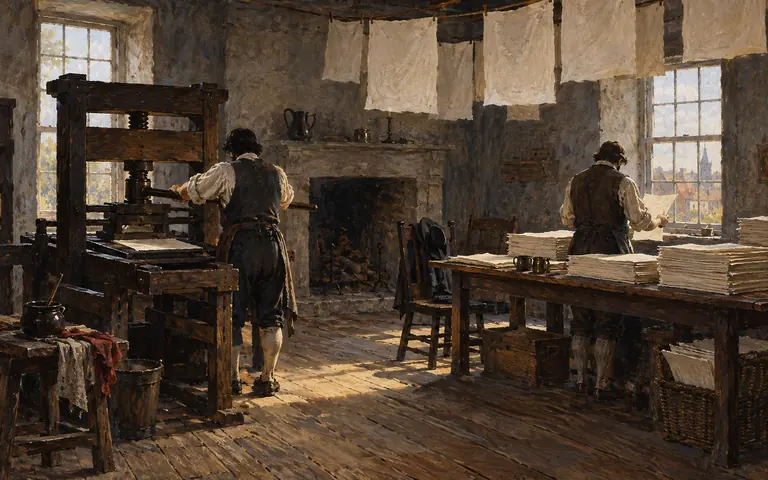
A press in front of you, and a decision on the stone

You are Tom Frazier, a printer's apprentice in Boston in 1773. Over ten years and twelve chapters you become a travelling journeyman, carrying letters between printing houses up and down the coast while the colonies go to war.

Every chapter puts a press in front of you and a decision on the stone. What do you print? Whose name stays out of the paper? Who do you protect when the committee comes to the door?

The towns, dates, newspapers and public events follow the historical record. Tom, his friends and what becomes of them are up to you, and the people you meet remember what you did.

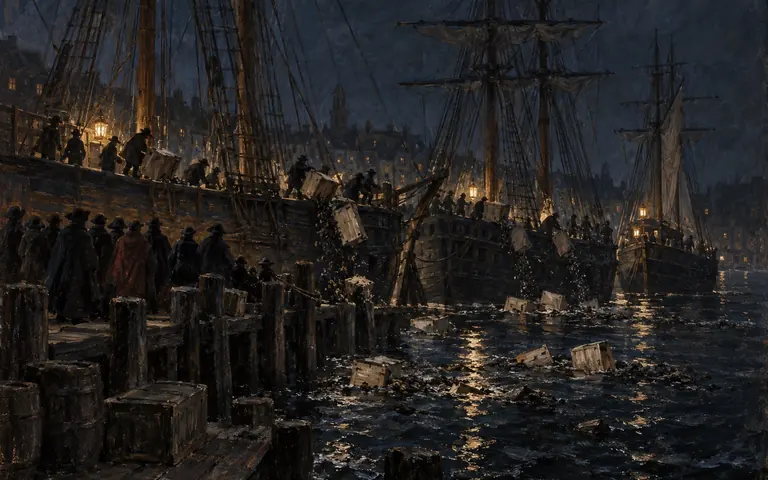
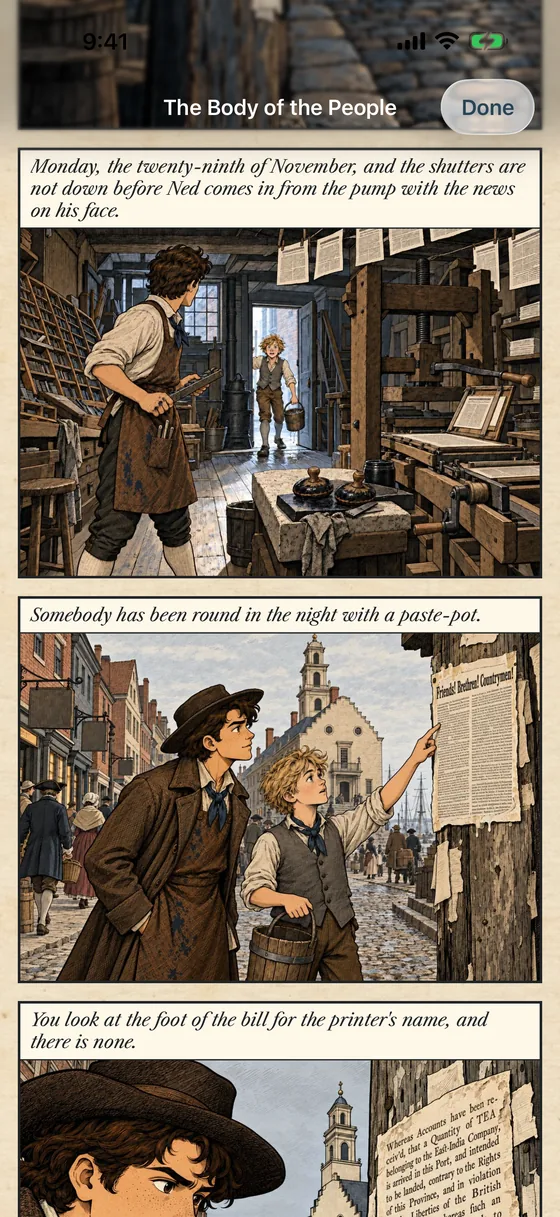
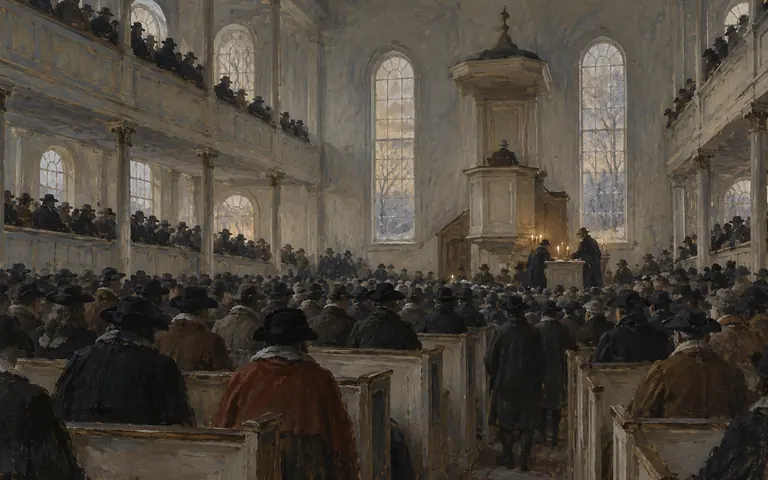
Ned comes into the printing shop from the pump with the news Tom reads the bill pasted on a post: Friends! Brethren! Countrymen! Caleb pulls Tom through the crowd at the Old South Meeting-House A broadside signed THE PEOPLE on a post in the street Men in blankets break open tea chests on a ship at night A disguised man with a hatchet at the ship's rail by lantern light
A snowy cobbled street of brick houses leading to the Town House; a bill pasted on a post in the foreground
King Street, Boston: one of the paintings in Chapter One

Hear the first page

Every word is read aloud

Every scene, choice, paper, journal entry and history note is read aloud, or read it yourself at your own pace. This is the opening of Chapter One, The Body of the People, as the game reads it.

Read along

Monday, the twenty-ninth of November, and the shutters are not down before Ned comes in from the pump with the news on his face. Somebody has been round in the night with a paste-pot. There is a bill on the post at the corner and, Ned swears, on every post from here to the Town House, and he cannot read the whole of it, but he can read the first line, which is the size of his hand.

Friends! Brethren! Countrymen!

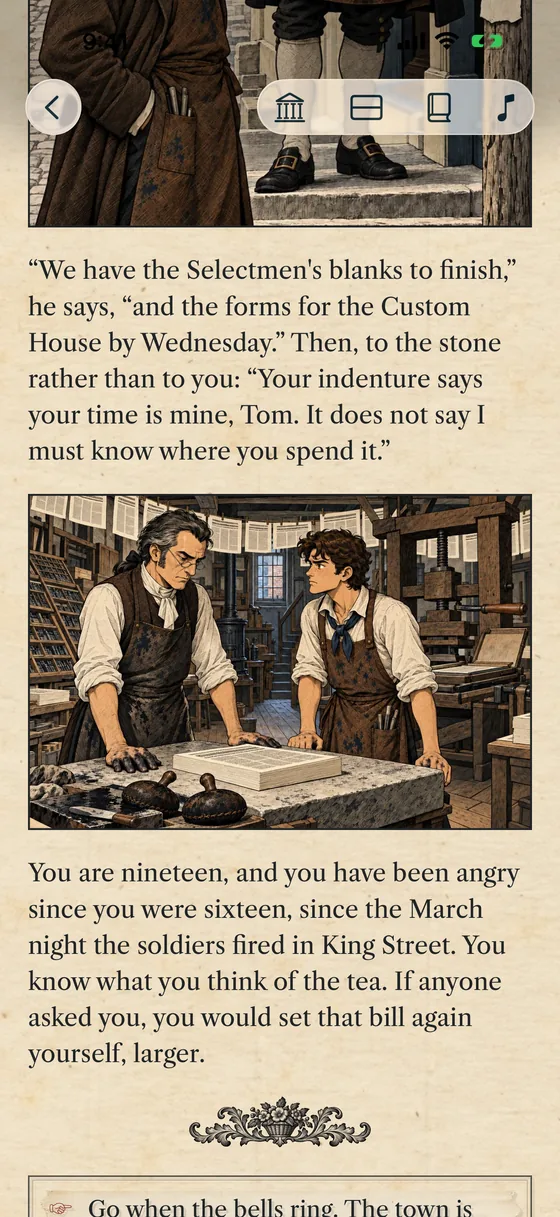
You have been nearly six years at Whitlow's, since you were fourteen, and you have a year and some months still to serve on your indenture. You can set a stick of long primer faster than the master now. You look at the foot of the bill for the printer's name, and there is none. Whitlow says a man who knows type can tell a shop by its worn letters, name or no name; you have never believed him. “That worst of plagues the detestable Tea shipped for this port by the East India company is now arrived in this harbour,” it says, and every friend to his country is called to Faneuil Hall at nine this morning, at which time the bells will ring.

Ellis Whitlow comes down with his coat half on and reads it from the doorstep with his spectacles pushed up, the way he reads proof. He does not say what he thinks. He has not said what he thinks about anything in King Street since you came to him, and you have stopped expecting it.

“We have the Selectmen's blanks to finish,” he says, “and the forms for the Custom House by Wednesday.” Then, to the stone rather than to you: “Your indenture says your time is mine, Tom. It does not say I must know where you spend it.”

You are nineteen, and you have been angry since you were sixteen, since the March night the soldiers fired in King Street. You know what you think of the tea. If anyone asked you, you would set that bill again yourself, larger.

Two wars. Two books. One press.

The books

The first chapter of each book is free to keep. The rest of each book is one purchase, shared with your family. No ads, no subscription, no account.

Book One cover: a hand holds a blank sheet to a candle at a window over a night harbour

Book One

The American Revolution

1773 to 1783 · twelve chapters in three Acts

From the tea in Boston harbour to the last day of 1783: Boston, Philadelphia, New York, Baltimore, Hartford, York, Newport and Annapolis.

Book Two cover: a satchel, a route-book and a composing stick at a window onto a snowy road

Book Two

The Printed War

1812 to 1815 · twelve chapters in three Acts

A generation on, Tom Frazier's apprentice takes his route through the War of 1812: Baltimore, Boston, the Ohio country, Pittsburgh, Burlington on Lake Champlain, Buffalo, Annapolis, Washington City, Hartford and New Orleans.

Book One · 1773 to 1783

Twelve chapters, twelve questions

Each chapter asks one question that has no safe answer.

Act One · The Liberty of the Press

1773 to 1776
  1. Night at a wooden wharf: three ships, small figures tipping chests into the water while a crowd watches
    Chapter One · Boston, November 1773The Body of the PeopleWhen men risk their necks in secret, do you print their names?
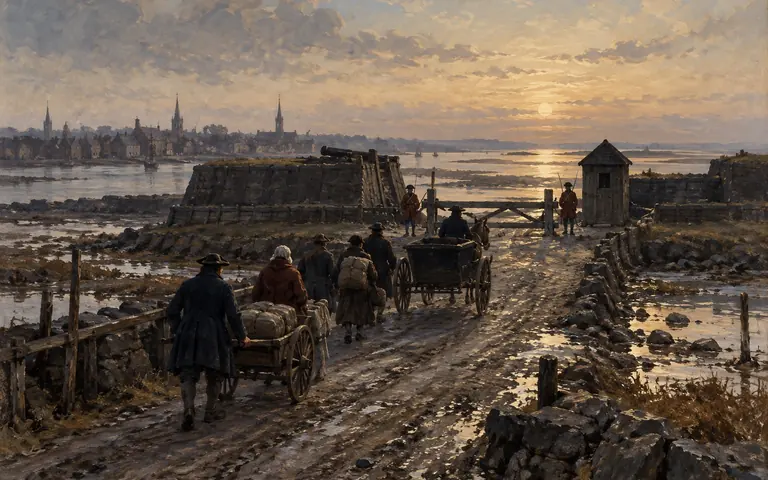
  2. At sunrise, people with bundles and carts wait at a gate in the town's earthworks
    Chapter Two · Boston, April 1775Five Papers to NoneWhich account do you carry out of a town at war, when everyone you trust has a side?
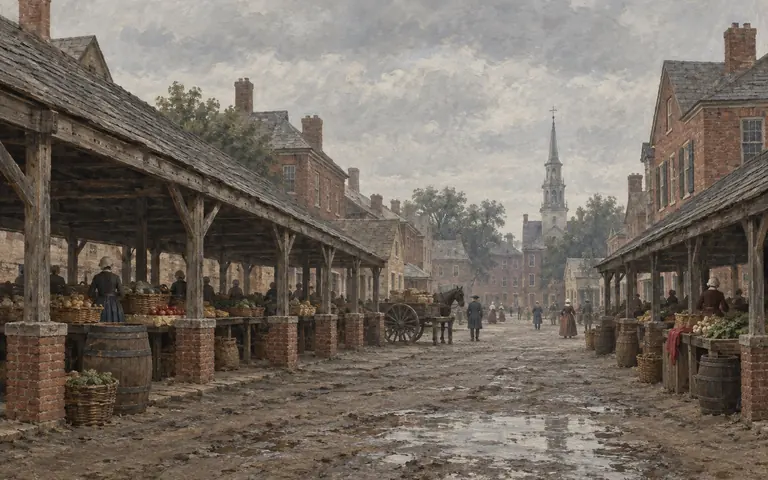
  3. Open market sheds on a wide street, baskets and barrels, people at midday
    Chapter Three · Philadelphia, July 1776The Unpaid AccountWill you risk the shop's credibility to keep it solvent?
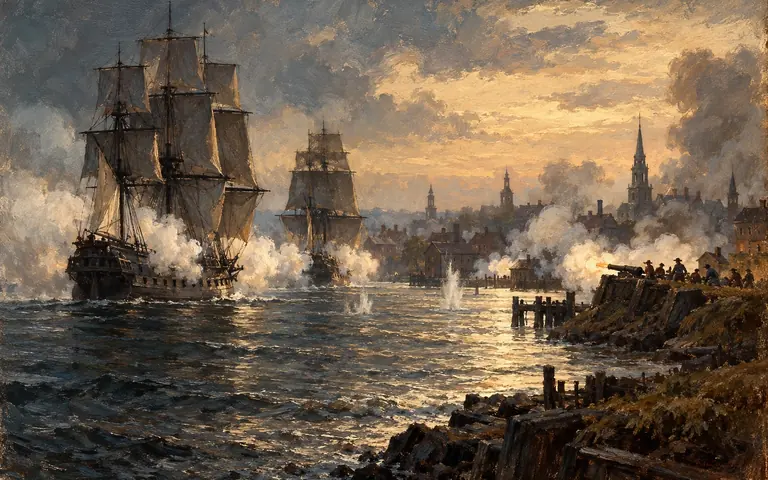
  4. Two warships under sail pass a waterfront in clouds of gun smoke
    Chapter Four · New York, July 1776The Name in the HatWhen two men who say they were there disagree, and the city may fall before you know, what do you print?

Act Two · The Divided Press

1777 and 1778
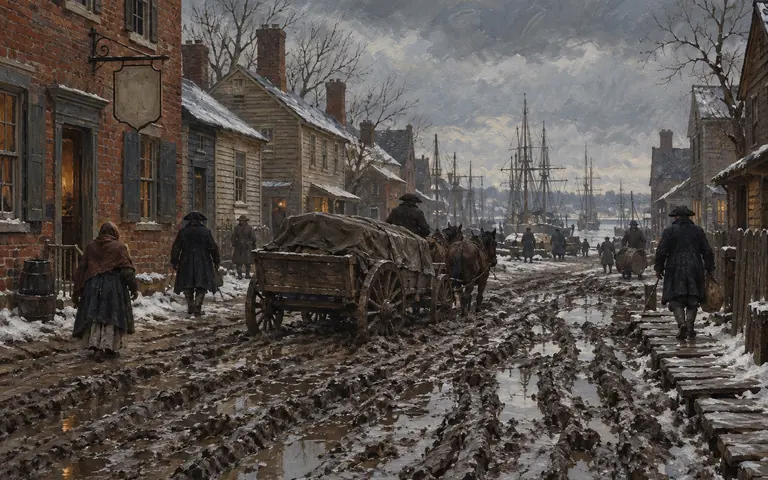
  1. A muddy unpaved street in winter, a wagon sunk to its hubs, masts at the end of the street
    Chapter Five · Baltimore, January 1777The Secrets of His PressWhen a town sets out to punish a printer, what do you save?
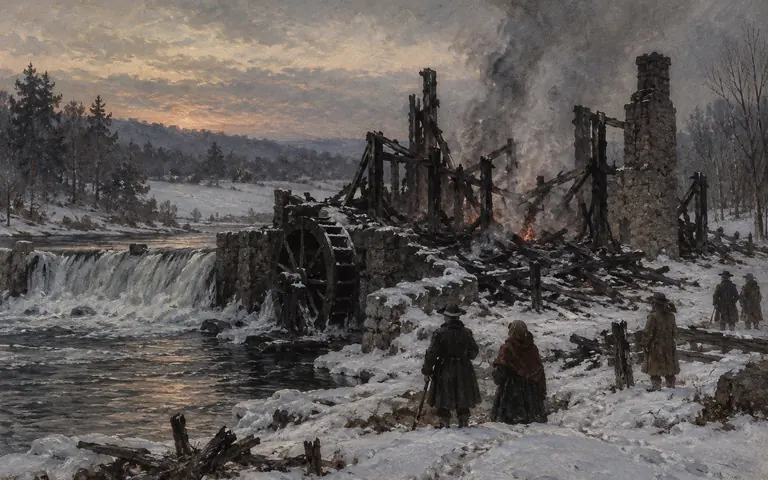
  2. Dawn on a snowy riverbank, the smoking frame of a burned mill beside its dam
    Chapter Six · Hartford, autumn 1777The Want of PaperWhen there is not enough paper for the truth and the town both, who gets it?
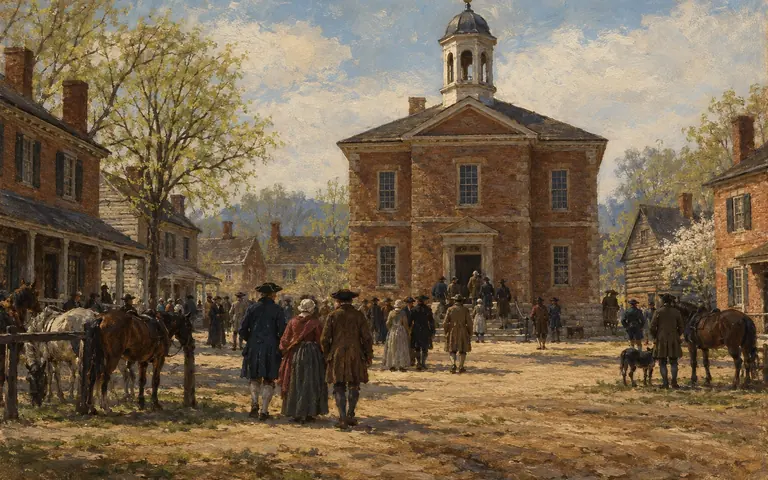
  3. A spring afternoon in a small town square, a brick court house with a cupola
    Chapter Seven · York, spring 1778The HearthWhen you find what nobody else knows to look for, whose is the finding?
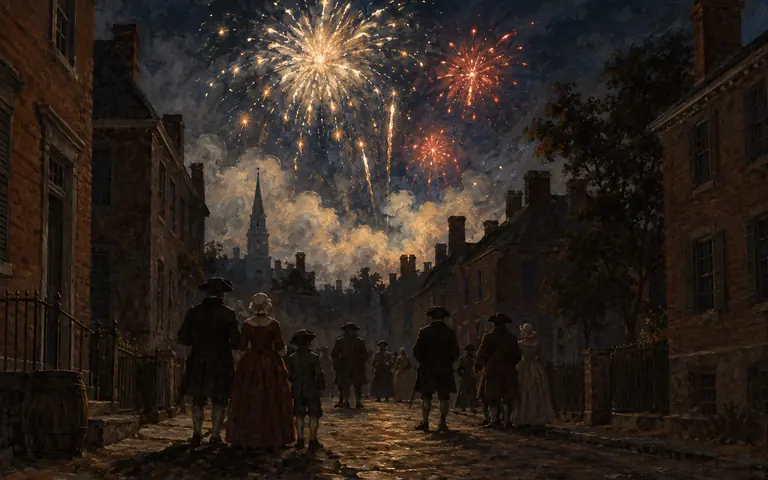
  4. Sky-rockets bursting over a street of brick houses at night
    Chapter Eight · Philadelphia, summer 1778The ListWhen the city judges the ones who stayed, whose name do you set?

Act Three · The Long Peace

1780 to 1783
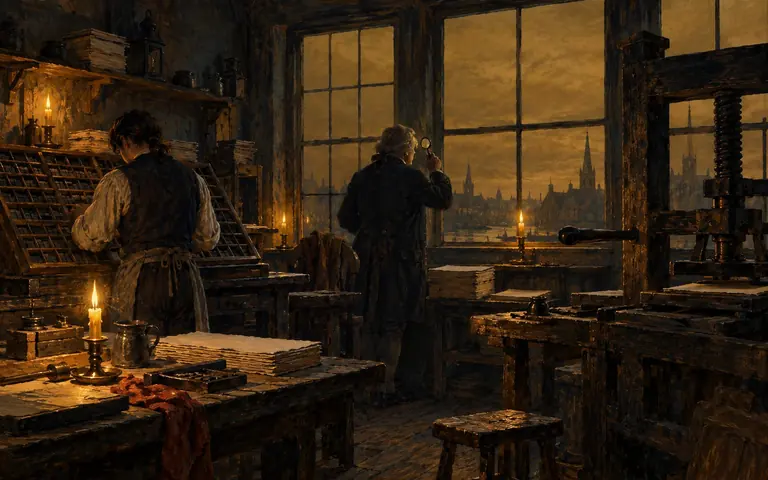
  1. A printing shop at noon lit only by candles under a dull yellow-brown sky
    Chapter Nine · Boston, May 1780Leave It to AstronomersWhen a frightened town wants to be told why, which explanation do you print?
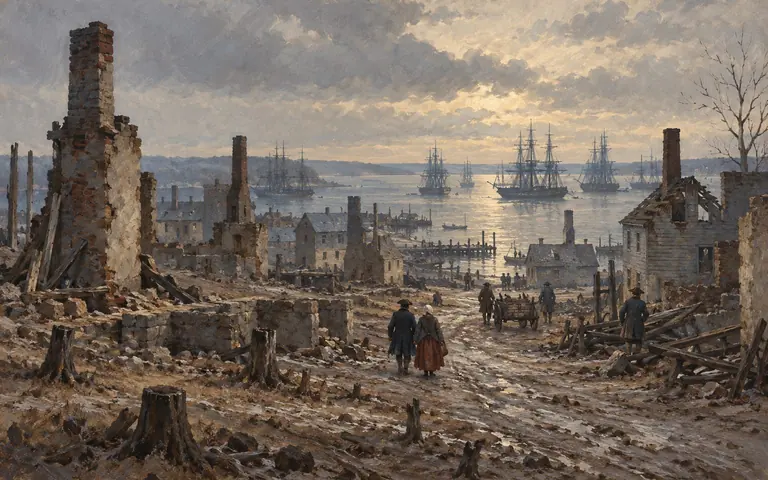
  2. A seaport town in grey November light, half its houses fallen, French warships in the harbour
    Chapter Ten · Newport, November 1780Old Rags Good for Making PaperWhen the truth about an ally would hurt the alliance, do you print it?
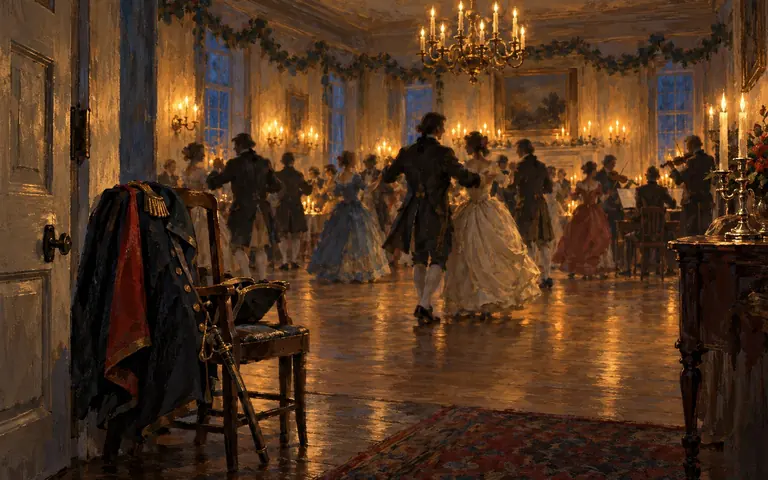
  3. A lamplit ballroom in a small river town, couples dancing, an officer's empty chair by the door
    Chapter Eleven · Annapolis, autumn 1781From MemoryWhen the best news of the war arrives as rumour, do you print it first, or print it right?
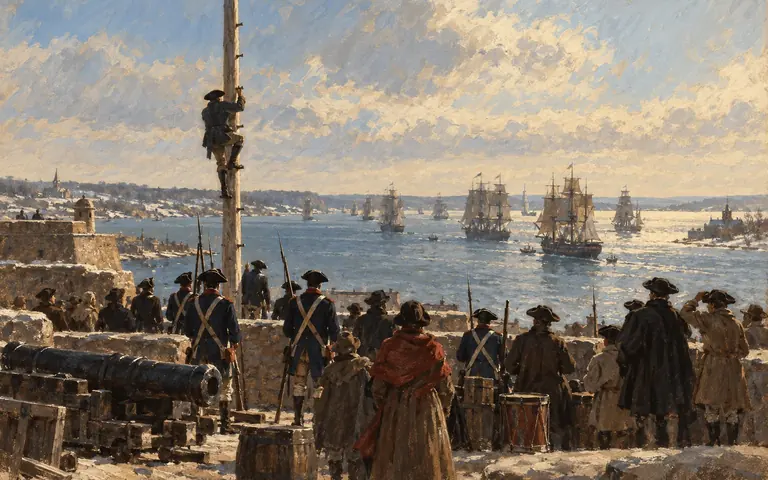
  4. A sailor climbs a greased flagpole while a crowd watches, the harbour full of departing ships
    Chapter Twelve · New York, November 1783He Discharged His HandsWhen the war is over, what do you print about the man whose road you took?

Book Two · 1812 to 1815

The Printed War

Three Acts: The Declared War, The Frontier and the Bay, and The Burning and the Peace.

  1. Chapter One · Baltimore, June 1812Who Set the Type
  2. Chapter Two · Baltimore, July 1812The Same Night
  3. Chapter Three · Boston, August 1812Whose Victory
  4. Chapter Four · Franklinton, Ohio, October 1812The Second Report
  5. Chapter Five · Pittsburgh, September 1813It Is Said
  6. Chapter Six · Burlington, Vermont, November 1813Whose Name at the Foot
  7. Chapter Seven · Buffalo, December 1813The Last Room on the Sled
  8. Chapter Eight · Annapolis, April 1814The Subscriber
  9. Chapter Nine · Washington City, August 1814Made the Night Before
  10. Chapter Ten · Baltimore, September 1814The Annexed Song
  11. Chapter Eleven · Hartford, December 1814Closed Doors
  12. Chapter Twelve · New Orleans, January 1815A Citizen of Louisiana
An engraved map of the coast, a dotted post road running from town to town

The post road

A journeyman's route

Tom carries letters between printing houses up and down the coast. Each town is a different press, a different master and a different idea of what a paper is for.

  • Boston 1773, 1775, 1780
  • Philadelphia 1776, 1778
  • New York 1776, 1783
  • Baltimore 1777
  • Hartford 1777
  • York 1778
  • Newport 1780
  • Annapolis 1781

Read, listen or look

The story, the way you want it

Engraved comic panels beside the words they show, a lettered comic of each chapter, a painting per scene, or text only.

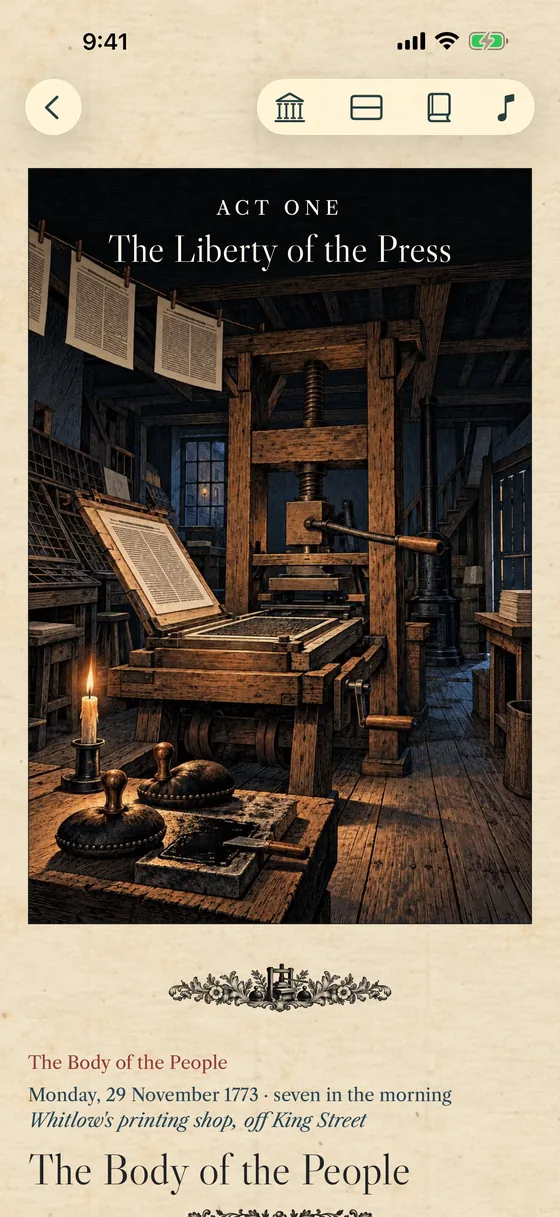
A scene: the Act One title painting of a press, then the scene's opening
A scene, with its painting
The chapter read as a lettered comic: panels with captions
The chapter as a lettered comic
A scene's words with its comic panel
Engraved panels beside the words
  • Choices that are rememberedThe people you meet remember what you did.
  • PapersLetters, bills and newspapers to read, and to hear read aloud.
  • JournalA journal that records your choices in plain words.

History, marked plainly

Documented, disputed, or fiction

Every scene has a History page that marks each point as documented, disputed or fiction, with its source. These are from Chapter One, word for word.

What is documented

“On Monday, December 20, Edes and Gill's Boston-Gazette reported it as the work of ‘A number of brave and resolute men’ and named no one.”

Source: Boston-Gazette, Dec 20, 1773, transcribed in the Massachusetts Historical Society's Documents Relating to the Boston Tea Party

What people disagreed about

“The accounts written that week do not agree. The Gazette said less than four hours and 342 chests; Governor Hutchinson wrote of about two hours and gave both 340 and 350 chests in different letters.”

Sources: Boston-Gazette, Dec 20, 1773; Hutchinson's letters, Colonial Society of Massachusetts vol. 99

What is invented

“Tom Frazier, Ellis and Hannah Whitlow, their shop off King Street, Ned, Caleb Ware and his mother … are fictional, as are their conversations and incidents.”

Real people appear only where the record puts them.
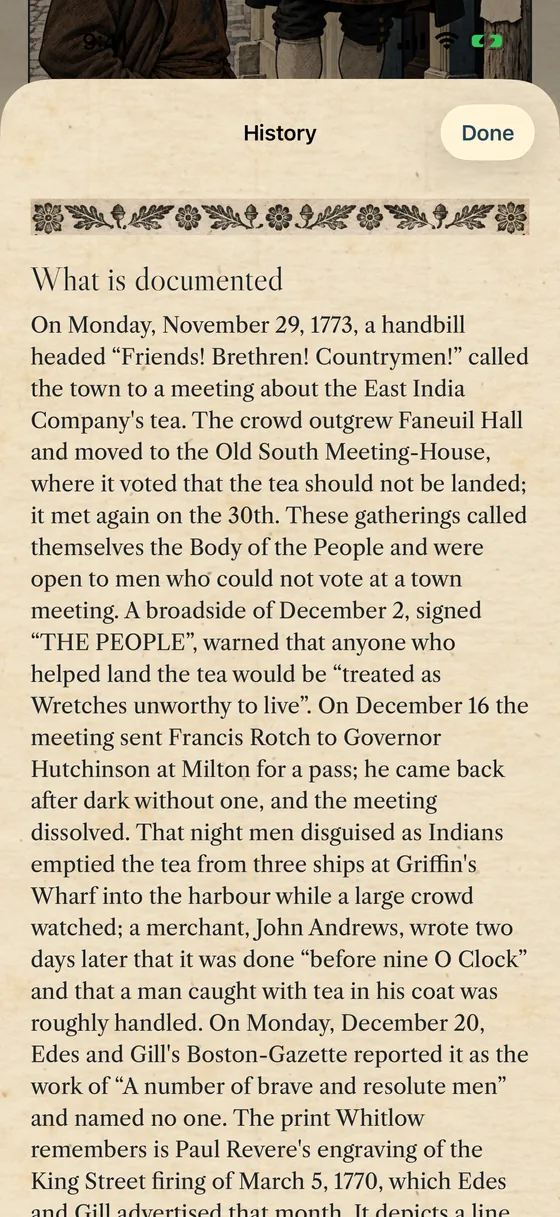
The History page for a scene: What is documented, with the account of the Body of the People
The History page in the game

A painting for every scene

Ten years of a country in the making

Recorded in the game

Watch it play

Real footage and the game's own narrator. The music is temporary.

What do you print?
Read, listen or look
The history is marked

Captured on iPhone and iPad

In the game

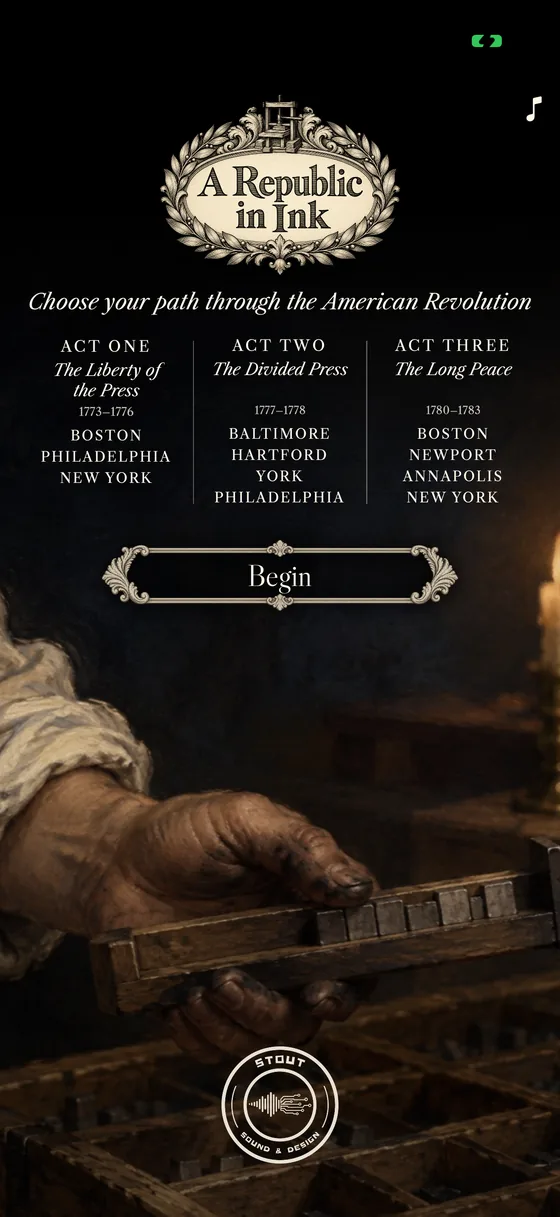
The title page: choose your path through the American Revolution, three Acts
The title page
Act One, The Liberty of the Press, and the first scene
A scene
A scene with its comic panel
Panels beside the words
The lettered comic of the chapter
The lettered comic
The History page
The History page
A scene on iPad The lettered comic on iPad

Plain dealing

One purchase per book. Nothing else.

  • The first chapter of each book is free to keep. The rest of each book is one purchase, shared with your family.
  • No ads, no subscription, no account, and nothing leaves your device. Your story is saved on your iPhone or iPad.
  • For players 13 and up. The game shows the period plainly, including slavery through real documents of the time, without gratuitous violence.

In development · Coming soon to iPhone and iPad

Be first to know when it launches

There is no release date yet. Leave your email address and we will write when the game is out.

Questions? Write to support@arepublicinink.com.

From the makers of Crown & Grail and Under Gaslight.